


Coffee sustainability in everyday enjoyment
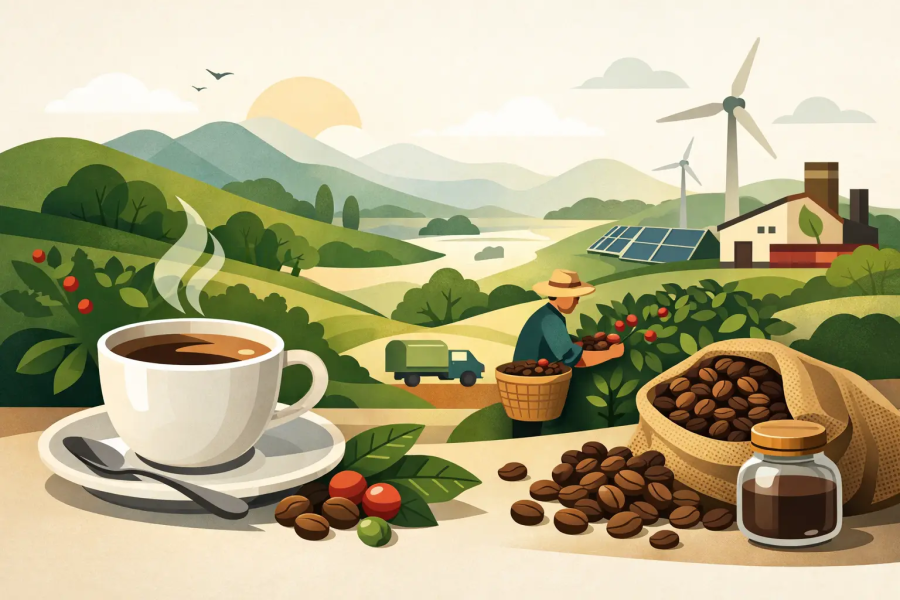
How coffee shapes sustainability from cultivation to the cup: origin, organic, fair trade, roasting and practical tips for conscious enjoyment at home, every day.
The aroma of freshly ground beans in the morning is a small ritual. But coffee sustainability begins long before the first sip: on the farm, during harvesting, in transport, at the roastery, and finally in your kitchen. Those who enjoy coffee consciously don't have to forgo dark chocolate in their espresso, caramel sweetness in their cup, or fruity cherry notes. On the contrary: making good choices regarding origin and quality often results in a coffee that tastes clearer, more distinctive, and simply better.
What coffee sustainability really means
Sustainable coffee isn't a single label or a promise that can simply be printed on a package. It's about the interplay of ecological, social, and economic issues. Are soils protected in the long term? Can coffee farmers make a living from their work? Is the quality maintained across many harvests? And how carefully are the beans processed, roasted, and packaged?
Coffee grows predominantly in regions around the equator. There, climate change, irregular rainy seasons, and rising temperatures directly impact harvests. High-quality Arabica coffees from high altitudes are particularly sensitive to these changes. Sustainability therefore also means promoting more resilient cultivation methods – such as shade trees, healthy mixed cropping systems, and careful water management.
At the same time, the issue shouldn't be oversimplified. Coffee transported from a great distance will always require some form of transportation. The crucial question, therefore, is not the unrealistic idea of a completely inconsequential product, but rather: Where along the value chain can tangible improvements be achieved without compromising quality and transparency?
Origin is the beginning of every good cup
The origin of a coffee reveals more than just the country on the label. Altitude, soil, microclimate, variety, and processing all determine whether a bean tastes more like honey and ripe fruit or like nuts, cocoa, and spices. Clearly stating the origin makes coffee traceable. This provides guidance for consumers and acknowledges the work of the people who grow it.
Single-origin coffees are particularly exciting. They allow you to experience the character of a specific region, for example, the vibrant fruitiness of an East African coffee or the smooth, chocolatey depth of a Latin American coffee. Blends also have their place: well-composed, they combine select qualities into a reliable flavor profile, such as for a balanced espresso with a rich crema.
For sustainable enjoyment, it's worth paying attention to specific details. General statements like "from the best cultivation" are not very helpful. Information about the region, altitude, harvest, or processing is much more informative. The more precisely a roastery describes its coffee, the easier it is to make an informed choice.
Organic is a strong sign, but not the whole answer.
Organic coffee stands for controlled organic cultivation. And we at Vee's are inspected and certified annually. The use of certain chemical-synthetic pesticides and fertilizers is prohibited, and crop rotation and soil health are given greater importance. This can protect landscapes and waterways and often promotes agriculture that works more closely with natural cycles.
Those who prefer organic products are making a clear choice for controlled standards. Those who also want to know what's in their cup demand transparency and choose suppliers who not only use buzzwords but also describe their coffee in an understandable way.
Fair value creation begins with price.
Coffee production is a labor of love. Ripe coffee cherries must be harvested, sorted, processed, and dried. Especially with selectively picked highland coffees, a great deal of expertise goes into each batch. A very low price can hardly reflect this work adequately.
A higher price alone doesn't guarantee fairness. However, it does create space for careful work, quality controls, and longer-term relationships. For coffee drinkers, this means: don't decide solely based on the price per kilogram. A cheap bean that tastes bitter, goes stale quickly, or only tastes good with lots of milk and sugar is rarely the better purchase.
The best coffee is one that arrives freshly roasted, is suited to your preferred brewing method, and delivers enjoyment even in a smaller quantity. A well-adjusted fully automatic coffee machine, an espresso machine, or a pour-over filter will extract more from high-quality beans than a large bag that has been sitting open in a cupboard for months.
The roast: Preserving quality instead of hiding it
Sustainability doesn't end at the source. The roasting process also determines how respectfully a high-quality bean is treated. A gentle roast, tailored to the specific variety, can bring out the natural aromas: milk chocolate, hazelnut, and caramel in an espresso; citrus, berries, or honey in a lighter filter coffee.
If roasting is too fast or for too short a time, subtle differences are often masked by unpleasant acidity. Very dark roasts can certainly be desirable – for example, for a strong, Italian-style espresso. However, they should not be used to conceal inferior green coffee quality or defects.
Roasting fresh beans daily, according to demand, offers another advantage: the beans reach you without unnecessarily long storage times. While they do need some rest immediately after roasting to allow gases to dissipate, their aroma then develops beautifully over several weeks. Therefore, it's best to buy quantities that you can enjoy within a reasonable timeframe.
Whole beans help to preserve aroma and resources.
If you own a coffee grinder, ideally you should buy whole beans and grind them just before brewing. This helps preserve the aroma and flavor for longer. It also prevents pre-ground coffee from losing intensity and ultimately tasting unsatisfactory.
Store coffee in a dry, dark, cool place with a tightly sealed container. The original bag with an aroma valve or a clean, light-proof tin is usually the best choice. These simple steps ensure less coffee is wasted—and that every cup delivers the flavor the bean was intended to produce.
Sustainable coffee at home: Preparation matters
You don't need to completely rearrange your kitchen to enjoy coffee mindfully. Start with what you do every day. Only prepare as much as you intend to drink. A thermos is useful if you plan on making several cups; a hot stovetop under freshly brewed coffee is rarely a good idea. It can cause aromas to deteriorate and quickly turn delicate notes into a dull, bitter taste.
Dosage also deserves attention. Using too little coffee often results in a weak, watery cup and wastes beans because the coffee lacks flavor. Too much coffee, on the other hand, can taste bitter and heavy. A kitchen scale or a measuring spoon will quickly help you find the right starting point. For filter coffee, about 60 grams per liter of water is a good guideline; for espresso, it depends on the filter, grinder, and recipe. For a single espresso, 8–10 grams would be a good starting point.
Coffee grounds don't necessarily have to end up in the trash. Small amounts, well distributed and not used excessively, can be used in the garden or on the compost heap. They are only suitable for houseplants with caution, as too much can promote mold or negatively alter the soil. Sustainability here also means: use them selectively rather than scattering well-intentioned amounts just anywhere.
Realistically consider packaging and shipping
Coffee needs protection from oxygen, light, and moisture, otherwise it can become rancid. Therefore, packaging must do more than just look good: it should preserve the aroma and ensure the beans reach you safely. Less material isn't automatically better if it means the coffee loses quality more quickly and ends up being thrown away.
It makes sense to bundle orders instead of sending a separate package for every small reorder. Sample packs also help you find your favorite variety without buying large quantities of a coffee that ultimately doesn't suit your taste.
At Vee's Coffee, daily hand-roasting is an integral part of this commitment to quality: the beans should arrive fresh, aromatic, and perfectly suited to your moment of enjoyment. Because the best decision for greater sustainability is one you'll be happy to make for years to come.
How to find your favorite conscious coffee
Don't start by asking yourself which coffee is "the most sustainable." Ask yourself which coffee you truly enjoy and drink regularly. Do you like a strong, low-acid espresso with notes of cocoa and caramel? Or are you looking for a vibrant coffee with fruity clarity for your pour-over brewing method? A coffee that suits your taste and brewing style won't end up as a half-empty package in your kitchen cupboard.
Then look for traceable origin information, organic options, and a fresh roast. If you're unsure, try smaller packages or sampler sets . Make a note of which aromas you like and how the coffee reacts in your machine. After just a few cups, the choice will become easier.
Don't turn your next coffee order into a perfection project, but rather a conscious decision made with good taste. Smell the freshly ground beans, take your time with the first sip, and choose a coffee whose journey and aroma truly resonate with you. This way, a daily ritual becomes a lingering pleasure.