


Arabica or Robusta: The difference in coffee
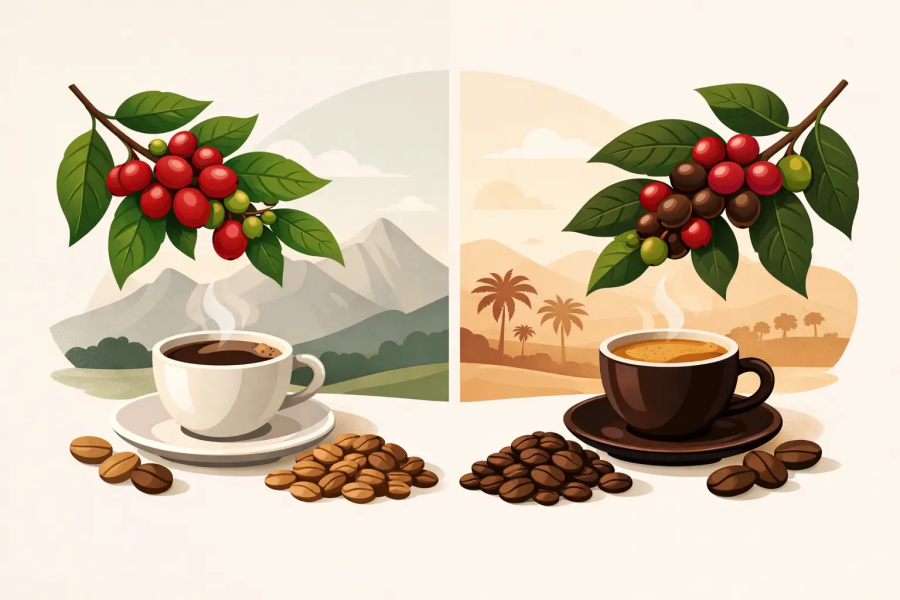
The difference between Arabica and Robusta: Find out how flavour, caffeine, origin and roast can influence your choice of espresso and coffee at home.
The aroma of freshly ground beans reveals a lot about a coffee even before the first sip. But when buying coffee, a fundamental question often comes into play: Arabica or Robusta? The difference isn't just in the caffeine content, but above all in the aroma, body, crema, and the way the coffee lingers on the tongue. Those who consciously choose their beans will more easily find the perfect coffee that wakes them up in the morning and brings true enjoyment in the afternoon.
Arabica or Robusta: Difference in origin and plant
Arabica and Robusta are two different types of coffee. Arabica, botanically known as Coffea arabica, has been prized for centuries for its complex and elegant aromas. The plant thrives best at higher altitudes with moderate temperatures. Many famous highland coffees from Ethiopia, Kenya, Colombia, or Guatemala therefore belong to the Arabica family.
Robusta is the common trade name for Coffea canephora. This coffee plant typically grows in lower-lying, warmer regions and is less sensitive to humidity, heat, and some pests. Major producing countries include Vietnam, Uganda, India, and Indonesia. Its characteristics make Robusta more predictable for many producers, but they don't necessarily indicate whether the coffee will taste good or bad.
This is precisely where a closer look is worthwhile: origin, altitude, harvest, processing, and roasting influence the cup at least as much as the coffee variety. A carefully harvested and gently roasted Robusta can taste surprisingly clean, chocolatey, and pleasantly spicy. A carelessly handled Arabica, on the other hand, loses even its delicate potential.
Taste: Fruity elegance or robust body?
Arabica is often described as delicate, aromatic, and balanced. Depending on its origin, it can taste of cherry, red berries, honey, caramel, citrus fruits, nuts, or dark chocolate. Many Arabicas have a lively, pleasant acidity. This isn't an unpleasant harshness, but rather a fresh, juicy vibrancy—comparable to the difference between a ripe cherry and lemon juice. How pronounced this acidity is depends heavily on the bean and the roast level.
Robusta usually brings more body and a more robust spiciness to the cup. Typical notes include cocoa, roasted nuts, wood, malt, and very dark chocolate. Good Robustas can be creamy and earthy without becoming bitter. Their acidity is often more restrained than that of Arabica, while the aftertaste can be more intense.
For filter coffee, many connoisseurs opt for single-origin Arabica beans when they're looking for clear origin notes and a fragrant cup. For espresso, the answer is more flexible. Here, Robusta can be a valuable partner: it gives the blend more body, a rich mouthfeel, and a stable, hazelnut-colored crema. An espresso blend with a select Robusta component doesn't automatically taste simpler—it can be wonderfully smooth and full-bodied, especially with milk. At Vee's, we always add 5% Robusta to our high-quality Arabica Grand Cru coffees for richness, spice, and a stable crema. With Robusta content exceeding 10%, the Robusta aromas begin to dominate and, in our opinion, increasingly detract from the overall taste experience.
Acidity is not the same as bitterness.
Those who say coffee is too acidic often mean something else: an unripe bean, incorrect preparation, or a grind that is too coarse. While Arabica beans generally contain more noticeable fruit acids, with the right roast, these can create a very harmonious flavor. Darker roasts tend to emphasize caramel, nut, and chocolate notes, while lighter roasts allow the origin and fruit flavors to shine through more clearly.
Robusta, on the other hand, is often associated with bitterness. But that's only half the story. Inferior or over-roasted beans can taste harsh. A high-quality Robusta, evenly roasted and blended at no more than 10%, produces body and a stable crema.
Caffeine and crema: What becomes noticeable in everyday life
Caffeine content is one of the most obvious differences. Robusta coffees generally contain significantly more caffeine than Arabica, often about twice as much. This makes it appealing to people who appreciate a particularly energizing espresso. Those who start feeling restless after their second cappuccino are often better off with a coffee that is predominantly Arabica or decaffeinated . A double espresso made with 95% Arabica beans is considerably more aromatic with a comparable amount of caffeine.
Caffeine isn't the only reason Robusta is popular in espresso blends. Its beans contain more substances that promote a dense crema during brewing. This is what creates that firm, fine-pored layer in the portafilter that makes an espresso so visually and tactilely appealing. However, achieving a beautiful crema requires more than just the right bean: freshness, grind size, dosage, water temperature, and brewing time must also be correct.
Arabica often delivers the more delicate aromas and a longer finish in espresso. Robusta provides the foundation and intensity. A good blend combines both, rather than masking either character. With milk, for example in a cappuccino or flat white, the cocoa and nutty notes of a Robusta component can certainly be present. When enjoyed straight, many people prefer a complex Arabica or a blend with a lower Robusta content of less than 10%.
How to recognize high-quality beans
The classification into Arabica and Robusta is a guideline, not a seal of quality. What matters is how carefully the coffee was managed from cultivation to roasting. Good beans come from traceable growing regions, are harvested when ripe, and are processed cleanly. During roasting, each variety needs time and attention so that the sugars and acids can develop a harmonious balance.
You can taste the freshness, too. Coffee gradually loses its volatile aromas after roasting . That's why Vee's Grand Cru coffee beans are freshly and gently roasted by hand every day and packaged while still warm. This preserves the nuances that make a coffee's origin unique – whether it's velvety chocolate, mild milk caramel notes, or the fruity clarity of a highland coffee.
At home, use whole beans and grind them as close to brewing time as possible. Store coffee in a dry, dark, and airtight container, or in the refrigerator. It's better to buy quantities that you'll enjoy within a few weeks, rather than letting a large supply sit for a long time.
Which bean is best suited to your preparation?
For pour-over, Chemex, or French press, single-origin Arabica beans are a great choice if you're looking to discover floral, fruity, or honey-sweet nuances. Adding 5% Robusta perfects the crema without compromising the aromas. In a French press, even chocolatey, slightly darker roasted Arabica beans produce a wonderfully smooth and full-bodied flavor.
With a fully automatic coffee machine, it all comes down to your personal preference. If you prefer a mild café crème with little bitterness, a well-balanced Arabica with less than 10% Robusta is often the right choice for a stable crema. For a strong coffee that remains noticeable even after adding a splash of milk, a blend with less than 10% Robusta is suitable. Don't set the grind too fine: a slow, over-extracted brewing process can make even the best coffee bitter.
Feel free to experiment with your portafilter machine. A pure Arabica espresso can be elegant, sweet, and complex, but generally doesn't produce a stable crema. A blend of Arabica and a maximum of 10% Robusta usually yields more crema, a richer body, and that classic Italian-style espresso character. There's no right or wrong here, just what you're looking for in your cup.
Arabica, Robusta, or a blend.
If you appreciate delicate aromas, a strong sense of origin, and a vibrant cup, start with Vee's single-origin Arabica coffees with 5% Robusta blend. And if you can't decide, a carefully crafted blend is often the most pleasing way to bridge the gap between the two.
Try different roasts in your own machine and note what you like: more chocolate or more fruit, a full body or a light, crisp flavor, pure espresso or coffee with milk. Ultimately, the best bean is the one whose aroma makes you want to linger in the kitchen a little longer in the morning.