


Coffee beans or coffee capsules - which tastes better?
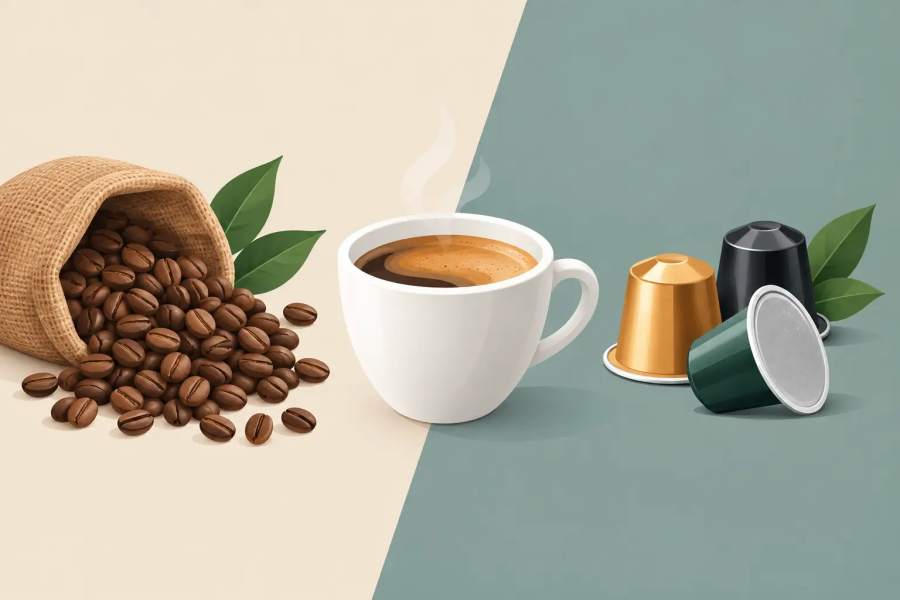
Coffee beans or coffee capsules? Find out what differentiates aroma, freshness, effort and waste – and which choice really suits you best in everyday life.
That first aroma in the morning often matters more than finding the quickest solution. With coffee beans or capsules, it's not just about the machine on the counter. It's about the freshness in the cup, the taste you love, your daily routine – and also about how much packaging comes with every espresso.
Capsules typically cost €60-80 per kg of coffee, while beans cost half that. For €35-40 per kg of beans, you can get top-quality coffee, whereas the quality of the ground beans in a capsule remains a mystery. And it's possible that capsules contain artificial flavorings. Brew the ground coffee from opened capsules and compare the aromas to the coffee from a freshly brewed capsule.
Capsules can be pleasantly uncomplicated. Good, freshly ground beans, on the other hand, offer a diversity of aromas that goes far beyond a quick caffeine kick. Anyone who has ever clearly experienced the notes of dark chocolate, caramel, ripe cherries, or honey in their cup understands: coffee can be convenient every day, but it doesn't have to taste generic.
Coffee beans or coffee capsules: The difference in the cup
The crucial difference begins long before brewing. Whole beans protect the volatile aromatic compounds inside. These are only released during grinding. This is precisely why freshly ground coffee smells so intense – and precisely why it usually tastes more complex.
While a capsule also contains ground coffee, usually packaged in a protective atmosphere, which preserves it better than an open package of ground coffee, some time still passes between grinding and brewing. During this time, some of the delicate aromas and flavors that bring a coffee to life are lost. This is particularly noticeable with single-origin highland coffees: their origin, natural sweetness, and elegant acidity are more clearly discernible in freshly ground beans.
That doesn't mean every capsule tastes bad. A well-tuned capsule can deliver a reliable, pleasing coffee. However, it largely determines the flavor and quantity. With beans, you decide: Should the espresso be strong and nutty? Should the coffee for the fully automatic machine be smooth, chocolatey, and low in acidity? Or do you prefer a lighter coffee with fruity notes for your pour-over? This freedom is a real advantage in terms of enjoyment.
Freshness is more than a roasting date.
Fresh beans need some time to rest after roasting so that the gases inside can escape. Afterward, the aroma develops beautifully over several weeks if the beans are stored in a dry, dark, and tightly sealed container. Daily, gentle hand-roasting and packaging the beans while still warm create an excellent foundation for this.
Your habits at home are also crucial. It's better to buy quantities that you'll use in a few weeks, rather than storing a large supply for months. Grind the beans as close to the time as possible before preparing them. This only takes a few seconds and noticeably changes the aroma in the kitchen.
Convenience: Capsule machine versus fully automatic machine and grinder
Capsules have a clear advantage here: insert the capsule, press the button, and you're done. This is practical in small offices, hotel rooms, or households where coffee is only drunk occasionally. The portion size is consistent, there's little coffee grounds left behind, and cleaning is usually quick and easy. However, they cost roughly twice as much.
Coffee beans require a little more attention. With a fully automatic machine, you fill the bean hopper, adjust the grind and beverage volume, and clean the machine regularly. With a portafilter machine, hand grinder, or filter coffee maker, there's a bit more manual work involved. But effort doesn't automatically mean inconvenience. Many coffee lovers appreciate precisely this brief routine: grinding the beans, inhaling the aroma, observing the extraction process, and consciously savoring the first cup.
For families or households with several coffee drinkers, quantity also plays a role. A fully automatic machine prepares many cups quickly, without requiring you to insert a new capsule for each serving. Those who like to switch between espresso, café crème, and latte can remain surprisingly flexible with the right beans and a few simple settings.
Anyone who wants control over taste
The coffee beans allow for precise adjustments to the brewing process. An espresso that brews too quickly can gain body with a finer grind. If the coffee tastes bitter and heavy, a slightly coarser grind or a shorter brewing time often helps. The amount of water and the temperature also affect the final result.
Capsules take these decisions off your hands. This can be a relief, but it also limits your options. This is particularly relevant for milk-based drinks: An espresso that tastes pleasantly strong on its own often needs sufficient depth for a cappuccino or latte macchiato to stand out alongside the milk. With espresso beans, you can tailor the result to your preferred milk and your cup.
Price: What does coffee really cost per cup?
A capsule coffee machine often seems attractive at first glance. The machines are compact and often available at a low price. However, over time, you pay for the convenience of individually portioned coffee. Capsules generally cost significantly more per cup than beans, especially if several people drink coffee daily.
Buying beans is usually more economical. One kilogram can yield many cups – depending on the dosage and type of coffee – roughly 100-120 cups of coffee or espresso. Additional costs may include a grinder, fully automatic machine, or portafilter. However, those who already own a suitable machine or drink coffee regularly will often find that buying beans saves them a significant amount of money.
Price shouldn't just be a number, though. A very cheap coffee that you don't like isn't a good choice. High-quality beans from traceable sources, carefully roasted and properly prepared, transform the daily ritual into a small moment of pleasure. Then not every cup will be the same – but every single one can be really good.
Packaging and the environment: An honest assessment
Capsules generate significantly more packaging per serving of coffee than beans. Aluminum capsules can be recycled if they are collected correctly and placed in the designated systems. Plastic or composite capsules present different challenges depending on the material and disposal method. Recycling is beneficial, but it does not replace the energy and raw materials required for production, transport, and processing.
With coffee beans, usually only the packaging of the entire quantity is generated. The coffee grounds remain as organic waste and, depending on local regulations, can be disposed of in the organic waste bin or composted. This isn't a free pass, however: cultivation, transport, roasting, and machinery use also contribute to the environmental impact. Nevertheless, the reduced portion size is a compelling argument for buying beans.
Those who use capsules don't need to feel guilty. It's advisable to consciously choose high-quality capsules, consistently use the return system, and avoid unnecessary purchases. However, for those who want to permanently reduce packaging, beans are the simpler solution.
Which option suits your coffee day?
Capsules are a good choice if you rarely drink coffee, have limited space, or want to reliably prepare a single cup without any adjustments. They are also a possible temporary solution if every minute really counts in the morning.
Beans are a particularly good choice if taste, freshness, and variety are important to you. They are worthwhile for heavy coffee drinkers, for households with several people, and for anyone who wants to choose their coffee according to the brewing method. A chocolatey, low-acid coffee can be a wonderful complement to a fully automatic machine, while a more vibrant, fruity variety, brewed with a filter, reveals its full origin.
You don't have to commit to a favorite coffee right away. Sample packs are a pleasant way to explore different countries, roast levels, and flavor profiles. At Vee's Coffee, these sample sets and the coffee finder help you choose the perfect beans from a wide selection of Grand Cru roasts to suit your machine, taste, and daily routine.
Ultimately, coffee should simply be a source of enjoyment. For a few days, place a fresh bean next to your usual capsule and take your time to compare the aroma, crema, mouthfeel, and aftertaste. Your own cup will usually answer the question more clearly than any external opinion.