


How to optimally grind coffee beans at home
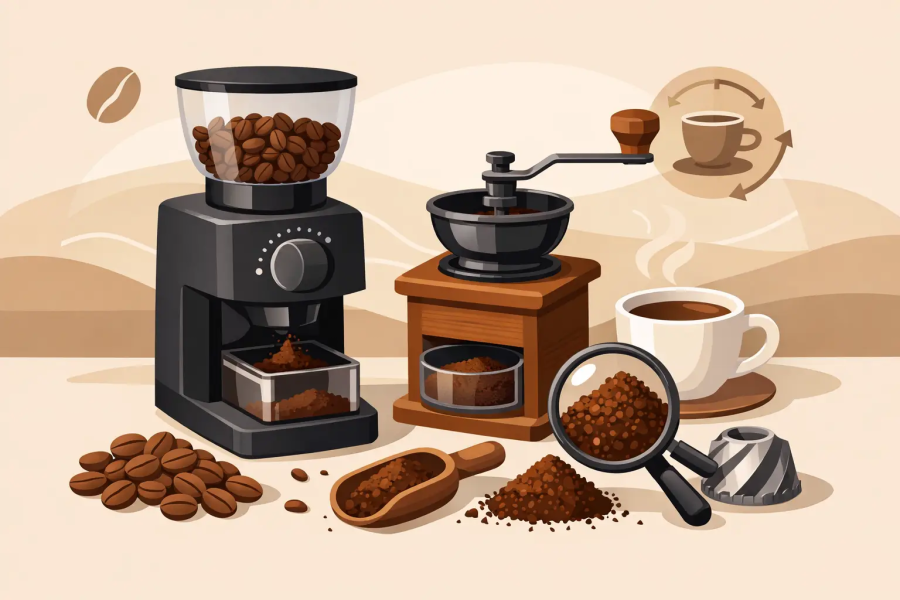
How to optimally grind coffee beans at home: Find the right grind for espresso, filter and French press - with tips for aroma, taste and freshness.
The first aroma after grinding reveals a lot: if the coffee smells of caramel, nuts, dark chocolate, or ripe cherries, the anticipation is justified. You don't need a barista lab to grind coffee beans perfectly at home. A good grinder, the right grind size, and the willingness to adjust the coffee to your own brewing method are crucial. The same bean can taste velvety and sweet as an espresso, but thin or bitter when brewed with a pour-over filter – depending on how finely it's ground.
Freshly roasted Grand Cru beans deserve this little bit of attention. It not only preserves the aroma, but also brings precisely those nuances to the cup that reflect the origin, harvest, and gentle roasting process.
Why the grind size controls the taste
During brewing, water extracts aromatic compounds, acids, sugars, and bitter substances from the coffee grounds. The finer the particles, the larger their surface area. The water then finds more points of contact more quickly. Coarsely ground coffee offers less surface area and therefore requires more time for flavor to develop.
If the grounds are too coarse, the water flows through too quickly or the coffee brews for too short a time. The cup then often tastes watery, harsh, acidic, or surprisingly bland. If the grind is too fine, the water is forced through, extracting too many bitter compounds, and the coffee can taste dry, harsh, or burnt. The goal lies somewhere in between: a balanced extraction with a clear sweetness, a pleasant texture, and a finish that makes you want another sip.
There is no setting that corresponds to the same number on every grinder. Setting 12 on one grinder can be finer than setting 4 on another. Therefore, rely on the result in the cup and the brewing time, not solely on a scale.
How to optimally grind coffee beans at home - the right grinder
For truly uniform coffee grounds, a grinder with a burr grinder is the most important step. Blade grinders chop beans rather randomly: in addition to dust, coarse pieces are produced. This mixture extracts unevenly and makes a clear, balanced flavor unnecessarily difficult to achieve.
A conical or disc burr grinder grinds significantly more precisely. Conical burr grinders are common in hand grinders and compact electric models, usually operate at a pleasantly slow speed, and generate little heat in the ground coffee. Disc burr grinders are frequently found in more powerful electric grinders and, when properly adjusted, deliver very consistent results. Both types can produce excellent coffee.
More important than the fundamental question is the build quality: The grinder should be easily adjustable and reliably cover the range of your preferred brewing methods. Someone who drinks filter coffee in the morning and espresso in the afternoon needs a grinder with sufficiently fine settings. For French press, Karlsbad coffee maker, or cold brew, a coarser setting is sufficient.
A hand grinder is a wonderful choice for single cups, travel, and quiet morning moments. However, grinding multiple portions or espresso can require patience. Electric grinders are more convenient and particularly practical for regular use. Don't choose based solely on noise level or design: consistency and precise adjustability are something you can taste every day.
Which grind size is best suited to your preparation?
The ideal grind depends primarily on contact time and pressure. A simple guideline is a consistency between very fine powder and coarse sea salt.
Espresso: fine, but not dusty
Espresso requires a fine grind. The water is forced through the coffee grounds under pressure in a short time and must extract enough aroma. A rough guideline is about 25 to 30 seconds for a double espresso, depending on the machine. If it runs too quickly and tastes acidic or weak, grind a little finer. If it drips slowly, tastes bitter and heavy, grind a little coarser.
Only change one factor at a time. Especially with espresso, the dose, the distribution in the portafilter, the tamping pressure, and the temperature all affect the result. If you change everything at once, you won't know what actually made the difference.
Hand filter and filter machine: medium for clarity and sweetness
For pour-over coffee, a medium grind is usually ideal, roughly between fine sand and table salt. This allows the water to flow through evenly and brings out the best in light, fruity highland coffees as well as chocolatey roasts. With a V60 or similar pour-over method, a brew should typically be complete in about two to three and a half minutes, depending on the amount of coffee.
With a filter coffee machine, the coffee grounds can usually be a bit coarser, especially if the water sits in the filter for a long time. If the coffee tastes harsh and dry, grind coarser. If it lacks depth or tastes acidic, try a finer grind. Freshly ground coffee with notes of honey, milk chocolate, or stone fruit truly shines in this context.
French press and Carlsbad coffee pot: significantly coarser
In a French press, coffee remains in direct contact with the water for several minutes. Therefore, use a coarse, uniform grind, similar to coarse sea salt. Grounds that are too fine will slip through the metal filter, making the cup muddy and potentially causing a bitter taste. After a four-minute brewing time, the correct grind will produce a full-bodied, smooth coffee.
The Carlsbad coffee pot works without a paper filter and also rewards a coarse grind. It reveals oils and texture particularly clearly. Those who prefer clear, light cups will likely opt for a paper filter. This isn't a question of quality, but rather a matter of preferred mouthfeel.
Grind fresh, but with care.
Ideally, grind your coffee just before brewing and only the amount you need. Ground coffee loses its aroma much faster than whole beans due to oxygen, light, and heat. The delicate, volatile aromas are the first to disappear. Whole beans, when stored properly, retain their aroma for significantly longer.
Store coffee in a cool, dry place away from light in a tightly sealed container or in its carefully sealed original packaging. Freezing is only practical if you are storing larger quantities in portions, completely airtight, and without constant thawing.
Don't fill the grinder's bean hopper weeks in advance. Light and room heat degrade the beans, and residue can remain in the grinder. It's better to weigh the portion just before grinding. For filter coffee, 60 grams of coffee per liter of water is a reliable starting point. For espresso, many setups use around 18 grams for a double shot, but the portafilter size and recipe can vary.
This is how you find your attitude without guesswork.
Choose a bean, a specific amount of water, and a recipe as your starting point. Grind a portion, brew it, and briefly note the grind size, brewing time, and taste. Afterward, adjust only the grind size in small increments. Two or three brews are often enough to clearly see the desired effect.
When tasting, pay attention to specific impressions. If the coffee tastes sour like unripe citrus fruit and thin at the same time, it usually needs more extraction—that means a finer grind, a longer brewing time, or slightly hotter water. If it tastes bitter, astringent, and overpowering, less extraction is needed—usually a coarser grind or a shorter brewing time. Fruity acidity isn't automatically a flaw: in Ethiopian coffee, it can be intentional and wonderfully vibrant. It only becomes unpleasant when sweetness, body, and balance are lacking.
Clean your grinder regularly. Coffee oils accumulate on the grinding mechanism and can develop a rancid taste over time. Brush out loose residue, use suitable grinder cleaners if necessary, and follow the manufacturer's instructions. Cleanliness makes a noticeable difference, especially when switching from a very dark espresso roast to a finer, lighter coffee.
At Vee's Coffee, beans are freshly and gently roasted by hand every day. With a suitable grinder, you can give this craft the final, crucial touch at home. Take a few cups for the initial setup – the moment when aroma, sweetness, and character perfectly harmonize is worth every small adjustment.