


What makes Grand Cru coffee so special?
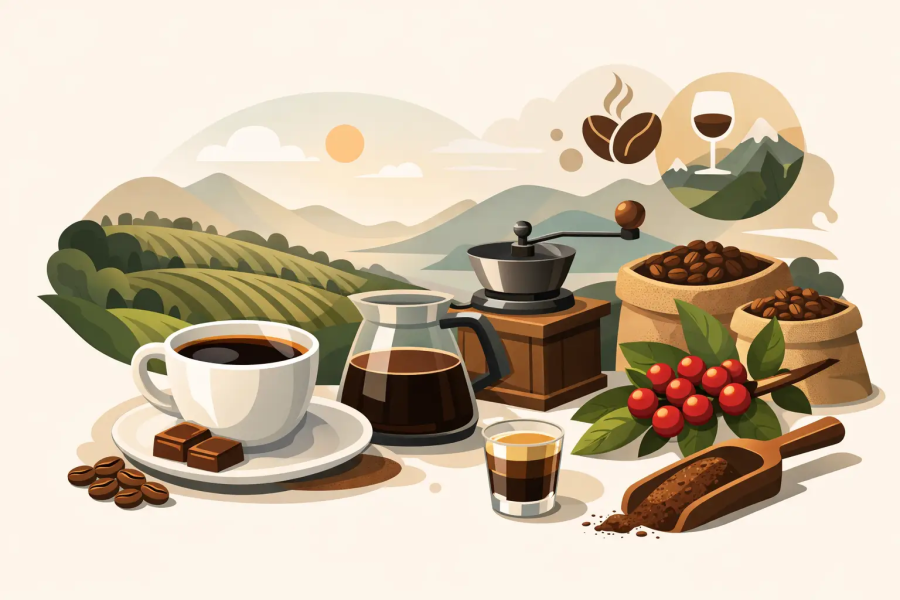
Grand Cru coffee is synonymous with careful selection, fresh roasting and distinct flavours. Find out how to recognise and enjoy top-quality coffee.
Hello! Do you also smell that aroma when freshly ground beans go into your cup? At Vee's, we coined the term "Grand Cru Coffee" in reference to top French wines. Many other roasters have adopted the term without understanding its meaning. "Grand Cru Coffee" begins precisely there: not with a grand promise on the packaging, but with the origin, the terroir, the hand-picked harvest of ripe beans, the careful hand-roasting, and the preparation. Vee's Grand Cru Coffee is coffee of the highest quality, made from the world's finest green coffee varieties. The aromas are more intense and complex, with notes of dark chocolate, nuts, fruits, spices, and caramel, for example. Grand Cru coffee beans accumulate a lot of sugar during their slow ripening process, which caramelizes during roasting.
What Grand Cru coffee means
The term Grand Cru originally comes from the world of wine. In coffee, it doesn't describe a globally protected category or a single flavor profile. Therefore, a closer look is worthwhile: Grand Cru in coffee refers to particularly carefully selected beans from high-quality growing regions, whose character is preserved through gentle roasting.
So it's not just about the country of origin. A coffee from Ethiopia, Sumatra, or Guatemala can be superb, but within a single country, altitude, soil, microclimate, variety, and processing methods can differ significantly. A single-origin highland coffee from a clearly defined region often reveals a great deal about that place. In the cup, this might manifest as an elegant sweetness, a delicate fruitiness, or a long, clean finish.
Grand Cru is therefore a quality promise developed by Vee's that must prove itself. Good beans, transparent origin, and meticulous craftsmanship belong together. If any of these are missing, the term remains merely a label.
The four characteristics of an exceptional coffee
Origin shapes character
Coffee plants are sensitive to their environment. At higher altitudes, the cherries usually grow more slowly. This can give the beans more time to develop complex sugars and flavor precursors. This doesn't automatically guarantee quality, but it provides a strong foundation for complex coffees.
African coffees can evoke notes of berries, citrus fruits, or jasmine. Coffees from Latin America often exhibit a balanced blend of chocolate, nut, and gentle fruit. Beans from India or Indonesia frequently bring spicy, earthy, or intensely cocoa-rich facets. Those who choose Grand Cru coffees are therefore not looking for the single best flavor, but rather the character that suits their individual cup.
The processing method is crucial.
After harvesting, the pulp of the coffee cherry is removed or dried along with the bean. This processing method significantly influences the final aroma. Washed coffees often taste clear, precise, and vibrant. Naturally processed coffees can offer more fruity sweetness and a richer texture. Honey-processed coffees often fall somewhere in between in terms of flavor.
For coffee connoisseurs, this means: fruitiness doesn't automatically equate to acidity. A high-quality coffee can have vibrant fruity notes and still be pleasantly balanced. Harsh, sharp acidity is more likely to result from unbalanced raw materials, an unsuitable roast, or faulty preparation than from origin alone.
The roast preserves rather than masking.
A top-quality coffee bean doesn't need a dark roast that makes all the differences taste the same. At the same time, light roast isn't automatically better. What's crucial is that the roast profile suits the coffee and the desired brewing method.
Gentle hand-roasting allows the bean to develop evenly. Sweetness, body, and delicate aromas can fully develop without bitterness or burnt notes becoming dominant. For filter coffee, the origin of the beans should often be particularly evident. Espresso usually requires more body, a stable sweetness, and sufficient depth so that the bean remains present even with milk.
Vee's coffee is roasted by hand daily and packaged while still warm. This is not a minor step: freshness determines how fragrant, full-bodied, and nuanced the coffee will be when it reaches your cup.
Freshness is a taste advantage
Coffee is a natural product. After roasting, gases are released, and aromas gradually change. Very freshly roasted beans, especially espresso beans, should rest for a while. This allows them to reach their full potential and develop beautifully.
Therefore, buy only what you need, rather than stockpiling for months. Store whole beans in a dark, dry place in a tightly sealed container – but not in the refrigerator. And grind them just before brewing. This single step alone makes the difference between a pleasant cup of coffee and a smell that fills the entire kitchen.
Prepare Grand Cru coffee properly
The best coffee doesn't require a complicated ritual. It just requires attention to a few basics. The water should be fresh and ideally not taste strongly of chlorine or limescale. The grinder should grind evenly. And the dosage should be adjusted to personal taste, rather than rigidly following a rule.
For filter brewing, clearly structured, light to medium roasted coffees are ideal. They reveal subtle nuances of cherry, honey, or milk chocolate particularly clearly. Start with about 60 grams of coffee per liter of water and then adjust the amount: the coffee will be too weak if there is too little coffee or if the grind is too coarse, and too bitter if the grind is too fine or the brewing time is too long.
When using a portafilter machine, many coffee enthusiasts prefer roasts with more body and lower perceived acidity. A good espresso combines a creamy texture with notes of cocoa, caramel, or roasted nuts. If it runs too quickly, it often lacks density. If it runs too slowly, bitterness and dryness can develop. Small adjustments to the grind size are more effective here than frantically changing the beans.
Even fully automatic machines can brew Grand Cru beans convincingly. Choose a roast that isn't too oily, clean the brewing unit and grinder regularly, and gradually adjust the grind finer until you achieve the right balance of sweetness and body. For a café crema, the extraction time can be slightly longer; for a concentrated coffee, a shorter extraction time is preferable.
Here's how to find your personal favorite
The question isn't: Which Grand Cru is objectively the best? The better question is: When and how do you drink your coffee? In the morning, it can be smooth, chocolatey, and uncomplicated. After a meal, an espresso can be stronger and spicier. For a leisurely afternoon, perhaps a fragrant highland coffee with fruity notes is just right.
If you're primarily familiar with dark, strong coffees, a well-balanced coffee with nutty, cocoa, or caramel notes is a good starting point. Those who love filter coffee and are curious about origin-specific flavors can explore floral or berry varieties. Sample packs are more practical than buying a large quantity: they allow for comparison without a single bean having to dictate the entire decision.
Organic coffee can be a suitable choice if controlled organic cultivation is important to you. However, it doesn't automatically guarantee a certain flavor and doesn't replace careful roasting. Likewise, decaffeinated coffee doesn't have to mean deprivation. Good decaffeinated beans can taste surprisingly full-bodied, sweet, and aromatic – ideal for late afternoon or evening.
How to truly recognize quality
When buying coffee, trust concrete information rather than grand superlatives. A traceable origin, details about the roasting process and flavor profile, and a recent roasting date provide significantly more guidance than terms like "premium" alone. The beans themselves also tell a story: they should look as uniform as possible and have a pleasant aroma, without being greasy or smelling burnt.
Quality is surprisingly easy to recognize in the cup. A good coffee is clear and balanced. It has sweetness, depth, and a pleasant aftertaste. It can be strong, but not harsh. It can be fruity, but not aggressively acidic. And it can be complex, without requiring you to become a coffee expert to enjoy it.
Take a quiet moment with your next cup. Smell it before your first sip, let the coffee briefly wash over your tongue, and notice what lingers. Perhaps it's dark chocolate, perhaps caramel, perhaps a surprising hint of cherry. It's precisely this small discovery that transforms Grand Cru coffee into a daily pleasure to look forward to.