


Arabica coffee bean origin simply explained
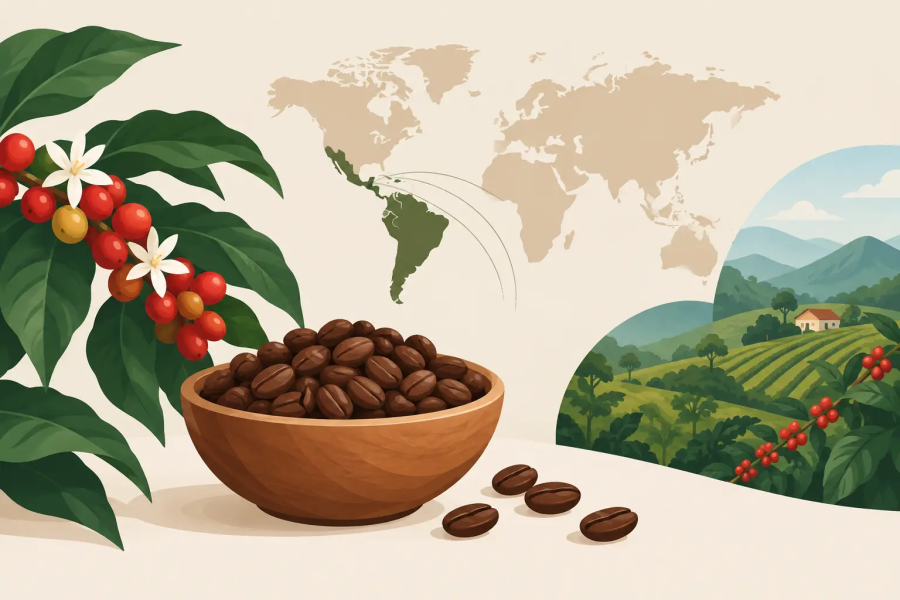
Our Arabica Coffee Bean Origin Guide explains how altitude, climate and processing shape taste, acidity and roasted aromas - clearly and in a way that is easy to enjoy.
When a coffee package says Ethiopia, Guatemala, or Papua New Guinea, it's more than just a geographical indication. This Arabica coffee bean origin guide shows why the same type of coffee can taste of jasmine and citrus, cherries, honey, or dark chocolate, depending on the growing region. Understanding the origin makes it easier to find the coffee that suits your taste and preferred brewing method.
What does Arabica mean in relation to coffee beans?
There are probably over a hundred Arabica varieties, either original or resulting from mutation and crossbreeding. The most important and oldest Arabica varieties are Heirloom, Geisha, Bourbon, and Typica. Others include Caturra, Catuai, SL28 (Kenya), Pacamara, Maragogype, and Catimor (Sumatra). The question of whether it's "Arabica" is relatively meaningless, as coffee quality depends on the variety, the terroir, and the processing.
Arabica is the umbrella term for over 100 coffee varieties, botanically known as Coffea arabica. It is considered particularly aromatic and complex, but is also demanding to cultivate. The plants prefer temperate temperatures, sufficient rainfall, and often higher altitudes. There, the coffee cherries ripen more slowly, giving them time to develop more sugars and complex flavor precursors.
However, Arabica coffee is not a uniform taste. There are often worlds of difference in taste between a washed bean from Kenya (SL 28) and a naturally processed coffee from Brazil (Yellow Bourbon). Origin, therefore, encompasses more than just the country. Crucial factors include region, altitude, variety, soil, climate, harvest, and processing. Only roasting then brings this potential to the cup.
Its origin lies in Ethiopia.
The genetic home of Arabica coffee lies in the southwestern highlands of Ethiopia. There, coffee grows, often heirloom varieties, sometimes still wild or semi-wild in forest gardens. Many Ethiopian Arabicas have a floral aroma reminiscent of bergamot, peach, or ripe berries and possess a lively, elegant acidity. This origin remains unmistakable, especially in lighter roasts.
Coffee traveled from the African highlands across the Red Sea to Yemen. There, it was not only cultivated but also became a trade commodity and an integral part of a vibrant coffee culture. This explains why Ethiopia is considered the botanical origin, while Arabia—especially Yemen with its port city of Mokha—is so significant for the early history of the coffee trade.
Arabica coffee beans origin: What you can read on the label
A country of origin is a good starting point, but not a complete description of the flavor. Colombia, for example, produces coffees from many regions: some soft and caramel-like, others juicy and fruity with a subtle acidity. A more specific description, such as Huila, Nariño, or Antioquia, can therefore be more helpful than the country name alone.
If the packaging says "Single Origin" or "single variety," the beans come from a defined region of origin, often even from a specific farm or cooperative, and frequently from different coffee varieties. This makes the character of the origin particularly tangible. Blends, on the other hand, pursue a different, equally worthwhile goal: Several coffees are combined in such a way that they produce, for example, a harmonious espresso with plenty of body, a crema-friendly texture, and a chocolatey finish (aroma, body, crema).
When it comes to Grand Cru coffees, it's worth paying close attention to the most precise information possible. Transparent origin isn't an end in itself; it indicates that selection, processing, and sensory profile are taken seriously.
Altitude: Slow ripening, clear aromas
Many high-quality Arabica coffees grow between approximately 1,000 and 2,000 meters above sea level. At cooler altitudes, the coffee cherries ripen more slowly than in the hot lowlands. The beans are often denser and develop a more nuanced flavor profile. This can manifest as a pronounced sweetness, delicate acidity, and a long finish.
Higher altitude isn't automatically better, though. A suitable location always depends on latitude, microclimate, and variety. Very high altitudes near the equator are often ideal, while coffee can thrive under different conditions in a lower-lying island region. What's crucial is whether the plant ripens healthily in the given location and whether the cherries are harvested carefully.
Soil and climate set the tone.
Volcanic soils, mineral content, rainfall, shade trees, and temperature patterns all shape the character of a coffee. Central American coffees often produce well-balanced Arabicas with notes of cocoa, nuts, and caramel. East African coffees tend to be more floral or fruity, with a clarity reminiscent of black tea. Brazilian Arabicas are often characterized by a full body, low to mild acidity, and notes of hazelnut, chocolate, and dried fruit.
Such descriptions are guidelines, not rigid rules. A good Brazilian coffee can be surprisingly fruity, a Rwandan coffee creamy and chocolatey. The harvest year, processing method, and roasting style significantly alter the flavor profile.
The preparation method plays a significant role in the taste.
After harvesting, the pulp must be separated from the coffee bean. This step greatly influences the aroma and mouthfeel. In the washed process, the pulp is removed before the beans dry. The result is often a clean, precise, and fresh taste. Floral nuances, citrus, and a delicate acidity are clearly evident.
In the natural process, on the other hand, the coffee cherries dry as whole fruits. During this time, the bean absorbs more fruity flavors. The coffee can taste fuller, sweeter, and more intensely of berries, dried fruits, or jam. This is exciting for those who love pronounced fruitiness. However, those seeking a very classic, smooth filter coffee often prefer a washed bean.
A third common variant is "honey" or pulped natural. In this case, some of the pulp remains attached to the bean. Depending on the specific method, this preparation combines juicy sweetness with a pleasant clarity. It demonstrates that origin is not a fixed recipe. Local people make decisions with expertise and care, decisions that later become audible—and, above all, gustatory—in the aroma.
From origin to the perfect cup
For filter coffee, the origin can definitely be the focus. Light to medium roasts allow the subtle nuances of an Ethiopian, Kenyan, or Colombian Arabica to shine through. Those who enjoy tea-like clarity, fruitiness, and floral aromas will find plenty to discover. Grind fresh and adjust the grind gradually: If the coffee tastes harsh or weak, a slightly finer grind or a higher dose usually helps.
For espresso, origin and roasting are equally crucial. A Brazilian Arabica or a well-balanced coffee from Central and South America often brings that nutty, chocolatey depth that works wonderfully in milk-based drinks. A darker, but gentler roast makes the espresso full and rounded without burning the bean. Low acidity doesn't mean tasteless: good acidity is like the freshness of a ripe fruit, while unpleasant acidity disrupts the balance.
Fruity Arabica coffees can be wonderful in an espresso machine, but they require some attention to temperature, quantity, and brewing time. For a simple cappuccino in the morning, a harmoniously roasted, full-bodied coffee is often the more reliable choice. It's not about which origin is objectively the best, but rather which aroma and aftertaste entice you to the kitchen in the morning.
Fresh roasting preserves what its origin created.
The finest quality green coffee loses its appeal if it is stored for too long or roasted too dark. Roasting should enhance the bean's unique characteristics. Chocolatey notes in a Brazilian Arabica should be given warmth and depth. In an Ethiopian bean, floral, honey, and fruity notes shouldn't be lost under a smoky roasted aroma.
Freshly roasted beans, gently roasted by hand daily, make this difference particularly noticeable. While coffee needs some time to degas immediately after roasting, after a few days it develops an exceptionally aromatic flavor. Store the beans in an airtight, dry, and dark place. It's best to buy a quantity that you can enjoy within a few weeks.
How to find your favorite Arabica
If you've only searched for "mild" or "strong" coffees so far, a slight change of perspective can help. First, ask yourself what you're craving: chocolate and nuts, caramel and milk chocolate, or cherry, honey, and light fruit? Then choose your brewing method. Full-bodied, rounded profiles are usually best suited for fully automatic coffee machines and milk-based drinks. For pour-over coffee, Chemex, or Aeropress, lighter, more complex, and vibrant profiles are ideal.
Sample packs are particularly useful for this. Brew two or three different coffees from the same origin as possible and note not only the flavor notes, but also your impression after the first sip. Does the coffee seem juicy or creamy? Do I like the acidity for its freshness, or am I looking for something more calm and chocolatey? This way, knowing the origin of the coffee becomes a truly personal choice of enjoyment, based solely on the label.
Hello! Can you smell that aroma of freshly ground coffee? Give a coffee's origin time, show it the proper way to prepare it – and let your own cup decide where your next coffee journey will take you.