


Why the roasting date is important for coffee beans
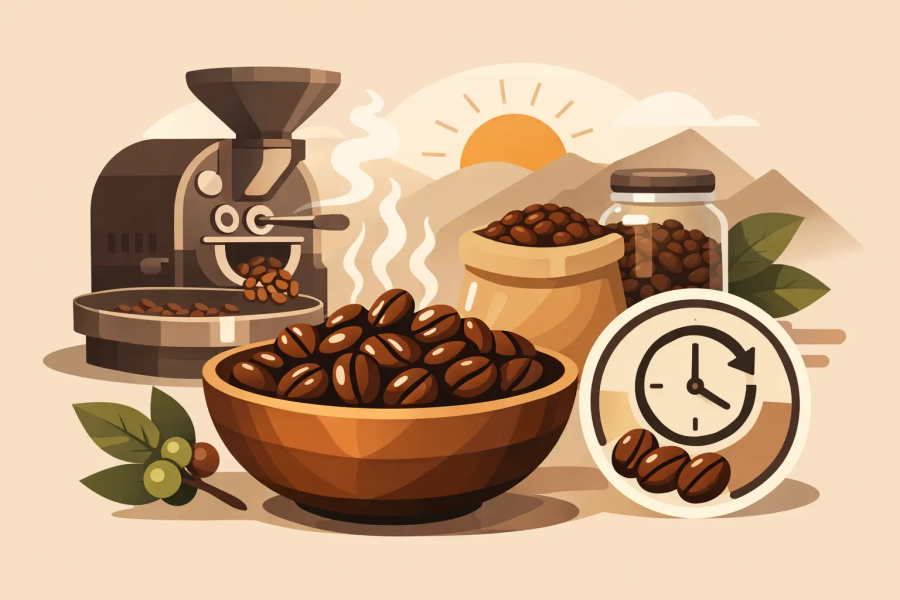
Why the roasting date is important for coffee beans: This is how you find the best time for full aroma, fine crema and successful coffee enjoyment at home.
The package is opened, and immediately the aroma of nuts, caramel, or dark chocolate rises. Freshness plays a crucial role at this precise moment. But why is the roasting date important for coffee beans ? Because coffee is not a finished, unchanging product after roasting. The bean continues to develop, releasing gases and thereby altering its aroma, flavor, and behavior in the cup.
Those who consciously select good coffee beans should therefore not only pay attention to origin, roast level, or organic certification. The roasting date helps to enjoy the coffee within the optimal timeframe. It is a reliable indicator of whether a bean is currently developing its aromatic potential – or whether it has already lost some of it.
Why the roasting date is important for coffee beans
During roasting, the aromas we love so much develop: chocolate, hazelnut, honey, cherry, malt, or delicate spices. At the same time, carbon dioxide forms inside the bean. After roasting, this gas gradually escapes. This process is called degassing.
Immediately after roasting, coffee is often still too lively. Especially with espresso, too much carbon dioxide can make the extraction unstable: the coffee flows unevenly, the crema appears coarse, and the flavor can seem somewhat harsh or closed off. The bean needs a little time to rest so that its aromas can develop harmoniously.
After this resting period, the particularly beautiful window begins. The aroma is clear, the sweetness more pronounced, and, depending on the coffee, fruity, nutty, or chocolatey notes come to the fore. With age, volatile aromatic compounds are gradually lost. Coffee doesn't go bad overnight, but it can taste flatter. What previously smelled of milk chocolate might then taste rather dry or papery. A fine, dense crema also often diminishes with older espresso beans.
The roasting date doesn't mean that coffee only tastes good on that one day. Rather, it shows where the beans are on their aromatic journey.
Freshly roasted doesn't always mean ready to brew immediately.
With coffee, "fresh" is a promise of quality, but not a synonym for "just roasted." The ideal resting time depends heavily on the brewing method, the roast profile, and even personal taste.
For filter coffee, French press, or pour-over, many roasts become very approachable after about three to seven days. The aromas open up without the gases unduly affecting the brewing process. Light, fruity highland coffees sometimes need a little more time. Their delicate notes of berries, citrus, or cherries often become particularly clear once the bean has had a chance to rest.
Espresso often takes longer to fully develop its flavor. A good guideline is about seven to fourteen days after roasting. Darker espresso roasts can become well-rounded, sweet, and creamy during this time. Depending on the bean and machine, the ideal moment might be later. If you find an espresso a bit too bold after eight days, don't judge too quickly. After a few more days, the same coffee can be significantly more balanced.
This is not a flaw in the bean, but part of its character. Especially with artisanally and gently roasted Grand Cru coffees , it's worth tasting this development.
The ideal enjoyment window depends on your preparation method.
General rules are helpful when it comes to coffee, but they don't replace personal taste. A strong espresso roast with notes of cocoa and caramel can still be exceptionally full-bodied and pleasant even after several weeks. A very light roast, complex coffee for pour-over, on the other hand, can benefit from a longer maturation period, but may lose its floral notes somewhat sooner.
As a practical guideline: Buy beans with a clearly stated roasting date whenever possible and plan your supply so that you can enjoy them within four to eight weeks of roasting. This isn't a strict expiration date. Well-packaged whole beans can still be enjoyable beyond that timeframe. However, those seeking maximum aroma, vibrant sweetness, and a beautiful crema will generally find this timeframe ideal.
Ground coffee loses its aroma much faster than whole beans. Due to the large surface area, oxygen and aromatic compounds come into direct contact. Therefore, a good grinder is often one of the most worthwhile investments for better coffee at home. Grind as close to brewing time as possible – the difference is noticeable from the very first aroma emanating from the grounds.
Roasting date and best before date: two different pieces of information
The best-before date answers a different question than the roasting date. It indicates until when a product should retain its typical characteristics if stored correctly. This information is useful and necessary for food products. However, it is less informative on its own for assessing coffee freshness.
A package of coffee can still have a long shelf life and yet no longer be at its aromatic peak. Conversely, coffee whose best-before date is approaching isn't automatically bad. The crucial factors are the condition of the beans, the packaging, and the storage. If the coffee smells musty, tastes noticeably bland, or develops rancid notes, its best moment has passed.
The roasting date creates transparency. It makes visible when the bean's journey after the roaster began. Those who view coffee not as a mere commodity, but as a luxury, can use this information to shop more effectively.
How to preserve the aroma after opening
Even the best roast loses its character if stored improperly. Oxygen, heat, light, and moisture are the biggest aroma thieves. Therefore, keep the beans in their tightly sealed original packaging whenever possible, provided it has an aroma release valve and a secure closure. The valve allows gases to escape without letting in much oxygen.
Store the package in a cool, dry and dark place - in the kitchen cupboard, not directly next to the stove, window or heater.
Buy quantities that match your consumption. If you drink two cups a day, smaller packages are often the more flavorful choice. For families, offices, or restaurants, larger quantities can be practical if they are consumed quickly and stored properly. Freshness isn't just created at the roastery, but also in your kitchen.
How to recognize fresh beans in the cup
The date is an excellent indicator, but your senses also play a crucial role. Fresh beans have a distinct and characteristic aroma before grinding. After grinding, the aroma becomes even more intense: perhaps reminiscent of roasted almonds, brown sugar, dark chocolate, or red fruits.
Freshness in espresso is often indicated by a dense, finely textured crema. However, this alone is not proof of quality, as the roast level, grinder, amount of coffee, and brewing time also influence it. In terms of taste, many connoisseurs desire a full body, a clear sweetness, and a long, pleasant finish. If the coffee is unusually bitter, woody, or bland, its age could be the cause. However, incorrect grinding, excessively hot water, or an unsuitable machine setting are also possible culprits.
With filter coffee, freshness is often less dramatic, but just as noticeable: the coffee tastes transparent, vibrant, and clean. Its origin should be recognizable. A coffee from Africa might exhibit delicate fruit and floral nuances, while a coffee from Latin America is more likely to have nutty, cocoa, or caramel notes. If everything tastes the same, it's worth checking the roasting date and storage conditions.
Buy coffee smarter by checking the roasting date
Daily, on-demand roasting is a real advantage for coffee lovers. It reduces the time beans spend unnoticed losing their aroma in storage or on shelves. At Vee's Coffee, beans are gently roasted by hand and freshly packaged – a great foundation for fragrant coffee at home.
Don't just order by name or intensity, but according to your daily routine. For espresso machines, the pack can rest for a few days if it arrives particularly fresh. For filter coffee, fully automatic machines, or French presses, you can start earlier and gradually work your way up to the desired flavor. A sampler pack is a delightful way to explore different origins and roasts within the optimal timeframe.
When you first open the package, feel free to write down the roasting date and your impressions: When does the coffee taste best to you? After one week, two, or four? With each package, you'll get to know your taste, your grinder, and your brewing method a little better. And that's exactly when a good bean becomes the coffee you truly look forward to in the morning.