


Organic coffee versus Fairtrade coffee: A comparison
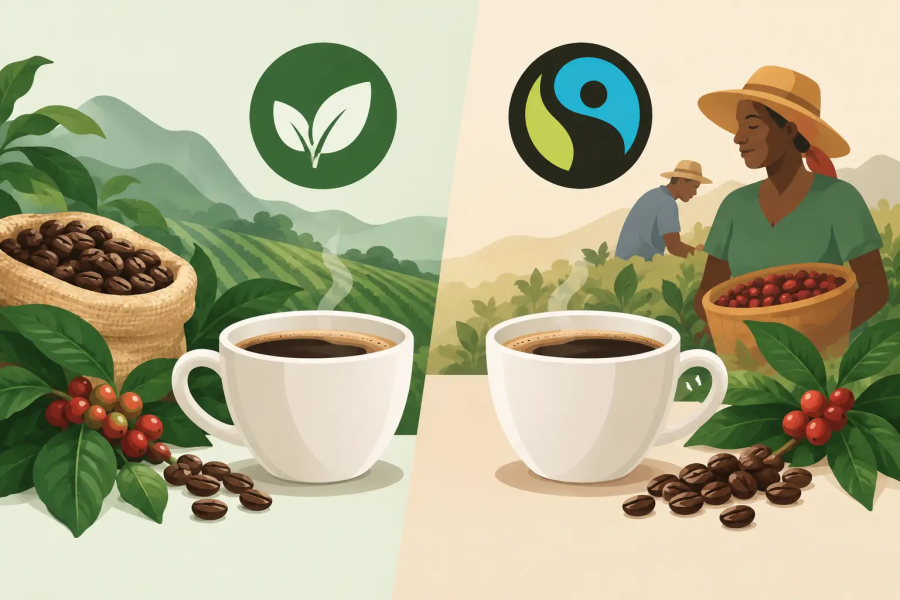
Organic coffee versus Fairtrade coffee: Learn what the labels mean for cultivation, trade and taste, and how to make conscious choices when shopping.
The aroma of freshly ground beans tells you nothing about the conditions under which the coffee was grown. This is precisely where the question of organic versus Fairtrade coffee becomes interesting: both terms represent more conscious coffee consumption, but they mean something fundamentally different. Those who understand the differences can choose their favorite coffee not only based on aroma, roast, and brewing method, but also on the values that are important to them.
Organic coffee versus Fairtrade coffee: the crucial difference
Organic coffee primarily describes its cultivation . For coffee to be sold as organic, it must meet the requirements of the respective organic certification. The focus is on natural cultivation methods: synthetic pesticides and mineral nitrogen fertilizers are prohibited, as are genetically modified organisms. Instead, farms use methods such as compost, shade trees, mixed cropping, and techniques designed to maintain long-term soil fertility.
Fairtrade coffee, on the other hand, focuses primarily on trade and the economic situation of the people who grow coffee. The standards aim to provide producers with better and more reliable trading conditions. Depending on the certification, this includes minimum prices, additional premiums for community projects, longer-term business relationships, requirements for working conditions, and organization in cooperatives.
The short rule of thumb is therefore: Organic primarily asks how the coffee was grown. Fairtrade primarily asks how it was traded. One label does not replace the other.
What changes in organic coffee cultivation
Coffee is a delicate plant. In many of its countries of origin, it grows at high altitudes under the protective canopy of trees, among banana plants or other crops. Such mixed cultivation can create habitats, reduce erosion, and improve water retention in the soil. Organic farming doesn't automatically mandate every single one of these measures, but it promotes a system that works more closely with natural cycles.
For coffee drinkers, organic is therefore primarily a choice for controlled cultivation standards. Those who value the absence of chemical-synthetic pesticides and fertilizers in cultivation will find clear guidance in the organic label .
However, this doesn't mean that all organic coffee tastes the same or is automatically exceptionally good. The quality in the cup still depends on the variety, altitude, climate, harvest time, processing, storage, and roasting. A carefully cultivated highland Arabica can have aromas of honey, yellow fruits, or cocoa. But if it's roasted too dark or stored for too long, these subtle nuances are lost.
Organic is not a taste profile.
Some people expect organic coffee to have a specific, particularly mild flavor. That would be too simplistic. A washed coffee from Ethiopia can exhibit vibrant notes of citrus and cherry, while a naturally processed organic coffee from Brazil is more reminiscent of nuts, caramel, and dark chocolate. What matters is not just the certification, but the interplay of origin, processing, and roasting expertise.
Especially with freshly roasted beans, it's worth paying attention to the description: Is the coffee intended for filter coffee, a fully automatic machine, or an espresso machine? Are you looking for a balanced, low-acid flavor profile or a light, fruity coffee? The organic label doesn't answer these questions about enjoyment—it complements them.
What Fairtrade coffee is supposed to achieve
Coffee is a vital source of income for millions of families. At the same time, global market prices fluctuate significantly, while rising costs, extreme weather events, and crop failures can make cultivation difficult. Fairtrade standards aim to provide greater planning security and strengthen the position of producers in the trade.
A key principle is the Fairtrade minimum price. If the market price falls below this minimum, it applies. If the market price is higher, the higher price is generally paid. Additionally, a Fairtrade premium can be invested in jointly agreed-upon projects – for example, in education, healthcare, infrastructure, or measures to promote more climate-resilient agriculture.
How visible the impact becomes on the ground depends on many factors: the size and structure of a cooperative, the decisions of its members, harvest yields, regional conditions, and the specific supply chain. Fairtrade is not a promise that every challenge in coffee cultivation has been solved. However, it is a plausible approach to making trading rules more binding and fairer.
Fairtrade is not automatically organic
Fairtrade coffee can be conventionally grown. In that case, it meets the social and economic standards of the Fairtrade system but does not carry organic certification. Conversely, organic coffee can be sold without a Fairtrade label, for example, if a producer uses other forms of cooperation or chooses not to obtain additional certification.
For shoppers, this means: If you want to cover both issues, look for organic and Fairtrade products . This combination unites controlled organic cultivation standards with trade standards. It's a compelling choice for many conscious coffee lovers – especially when origin and taste are described transparently.
The best choice depends on your priority.
There is no single "better" coffee. If protecting soil, water, and farmland is particularly important to you, organic coffee is the obvious choice. If you primarily want to consider the economic situation of coffee farms and cooperatives, Fairtrade coffee might be your best option. If you want to combine both, specifically look for dual certification.
Furthermore, one question shouldn't be overlooked: Do you like the coffee? Sustainability and enjoyment go hand in hand if you want to regularly enjoy coffee. A bean that sits unused in the cupboard helps no one. That's why it's always worthwhile to read certifications along with specific information about origin, roast level, and flavor profile.
A nutty, chocolatey coffee with low acidity is often a perfect match for fully automatic coffee machines or as a café crème for breakfast. For a portafilter machine, an espresso roast with a full body and notes of cocoa, caramel, or milk chocolate is ideal. Those who prefer pour-over coffee might enjoy discovering clean, fruity highland coffees. Organic and Fairtrade options are available in all these styles.
However, it's important to remember that high-quality green coffees are rarely traded under fair trade conditions, but rather command a price above average. Fairtrade green coffees become more expensive due to certifications, without any improvement in quality, and are nevertheless cheaper than high-quality green coffees.
Why freshness counts despite seals
The best green coffee concept only unfolds through proper processing. Coffee is a natural product, and roasting determines whether its valuable aromas are clearly expressed. A gentle, needs-based roast can preserve sweetness, body, and subtle origin notes without emphasizing any burnt nuances.
Even after roasting, time begins to tick away. Freshly roasted beans initially release carbon dioxide and need some time to rest before they develop their full aroma. Afterward, airtight, light-protected storage is essential. It's better to buy quantities that you can enjoy within a few weeks rather than leaving a large supply open for an extended period.
At Vee's Coffee, organic-certified roasts aren't simply categorized by their labels. Like any Grand Cru coffee, they're judged by what happens in the cup: aroma, balance, sweetness, body, and a clean finish. Because a consciously chosen coffee shouldn't taste like deprivation, but rather like a good moment.
How to read coffee information effectively
When buying coffee, first look for the existing seal and then ask yourself what it means. Organic stands for controlled cultivation methods. Fairtrade stands for established trading standards. If the coffee bears both labels, it combines both perspectives.
Next, it's worth taking a look at the information that directly influences your enjoyment: the country of origin, the region or farm, the altitude, the processing method, and the recommended brewing instructions. A traceable origin isn't a guarantee of your personal favorite flavor, but it does make the selection more tangible. Sample packs are particularly helpful if you want to find out whether you prefer caramel, spicy, or fruity coffees.
And then: Prepare the beans carefully. Grind them as fresh as possible, use clean water, and adjust the grind and dosage to your brewing method. This way, the coffee receives the attention it deserves from cultivation and trade.
A seal of approval can provide guidance, but the best decision comes from knowledge and anticipation: Choose a coffee whose origin convinces you, whose values suit you, and whose aroma entices you to the kitchen in the morning.