


Single-origin coffee or blend? Which suits you best?
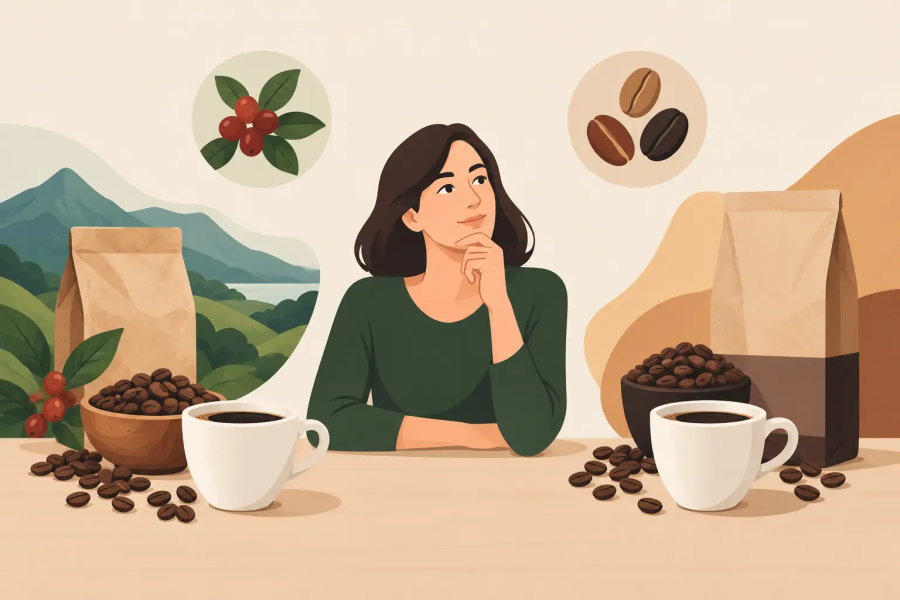
Single-origin coffee or blend? Find the roast that best suits your taste, preparation, and coffee enjoyment, both now and in the long term.
The initial aroma after grinding, the crema in the cup, a lingering hint of dark chocolate, caramel, or ripe cherry: when it comes to single-origin coffee versus blend, it's not a question of right or wrong. It's about which coffee suits your taste and reveals its best qualities in your favorite brewing method. Those who want to taste the origin will find it in a single variety. Those looking for a reliable espresso for every morning might learn to love a good blend.
Single-origin coffee or blend: the crucial difference
Single-origin coffee comes from a clearly defined origin. This can be a specific country, a region, a farm, or even a single lot. The beans are not blended with other coffees. This allows their individual character to remain the focus: the floral aroma of an Ethiopian highland coffee, the honeyed sweetness of a Central American coffee, or the nutty, chocolatey depth of a Brazilian Arabica. Nevertheless, some coffee farms blend different Arabica varieties on the farm itself for a more complex aroma. This is because Arabica is not just Arabica, but a general term encompassing numerous Arabica varieties, similar to the many different grape varieties.
A blend, on the other hand, is a deliberately composed mixture of different coffees, often from distant growing regions or continents. The roastery combines beans with different characteristics so that they complement each other. One variety might provide sweetness and body, a second delicate fruitiness, and a third a rich, long-lasting crema. The result is not a random mixture, but ideally a flavor composition with a clear concept.
Neither a single variety nor a blend is automatically of higher quality. The crucial factors are the quality of the green coffee, careful selection, the appropriate roasting, and freshness. Grand Cru coffee deserves attention, regardless of whether it's roasted on its own or as part of a successful blend. A "single origin" can therefore only work with near-perfect green coffees, such as, but not limited to, Yemen Mokha, Kenya, Java, Sumatra, Guatemala, Costa Rica, Hawaii, and Jamaica Blue Mountain. Nevertheless, at Vee's, we still add 5% of the best quality Robusta for a stable crema, which significantly enhances the taste experience.
What makes single-origin coffee so exciting
Single-origin coffees are particularly appealing to curious connoisseurs. They make origin directly tangible. Even comparing two Arabica coffees from different growing regions clearly demonstrates how strongly climate, soil, altitude, processing, and harvesting influence the flavor. Coffee is not a uniform product, but a natural product with its own unique character.
Ethiopian coffee can evoke notes of jasmine, bergamot, and light fruits. Colombian coffee is often well-balanced, with hints of caramel, red fruits, or cocoa. Brazilian beans frequently bring a full body and aromas of nuts, milk chocolate, and brown sugar to the cup. Such descriptions are not rigid guidelines; they merely provide a guide to the potential of a freshly roasted bean.
Often a particularly nice choice for filter coffee
Whether brewed using a hand filter, a French press, or a fully automatic coffee machine as a café crème, single-origin coffees can beautifully unfold their subtle nuances. Light to medium roasts often reveal the origin particularly clearly. Those who enjoy consciously experimenting, adjusting the grind and brewing temperature, or distinguishing between breakfast coffee and afternoon indulgence will find plenty of variety here.
This doesn't mean that single-origin coffee always has to taste light and fruity. A slightly darker roast can reduce acidity and highlight notes of chocolate, roasted nuts, and caramel. For those seeking an aromatic coffee without harsh acidity, the roast profile is just as important as the country of origin.
The slight downside: Character can also be polarizing.
A coffee with a strong, distinctive profile won't appeal to everyone. Pronounced fruitiness, hints of wine, or floral notes are fascinating, but may be less pronounced in a milk-based beverage. Furthermore, natural products vary slightly from harvest to harvest. This isn't a flaw, but rather part of their authenticity. Those who always expect the exact same taste might prefer a harmoniously blended coffee.
Why a good blend is not a compromise
Blends have long been underestimated, as if single origins were inherently more prestigious. In reality, a high-quality blend requires considerable expertise. The beans must complement each other sensorially, the recipe should be convincing in everyday use, and each component needs the roasting process that suits it best. Some coffees are therefore roasted individually before blending. This allows each variety to develop its optimal aroma.
A good espresso blend is often designed to taste intense on its own and not get lost even in higher-fat milk, like Vee's espressos, for example. It combines a full body with sweetness, low bitterness, and a stable crema. Aromas of dark chocolate, cocoa, malt, or caramel harmonize particularly well with milk and plant-based alternatives. This is a great advantage for cappuccinos, lattes, and flat whites.
Blends are also practical in offices or households with diverse preferences. They deliver a reliable, balanced cup without turning every drink into a mini-tasting. This is no less sophisticated enjoyment. It's coffee that reliably brings pleasure – in the morning before the first meeting, just as much as after a meal.
The preparation will show you the way
The question of single-origin coffee or blend is best answered by considering your preferred brewing method. For filter coffee, Chemex, and pour-over, single origins often offer a particularly exciting aromatic journey. Those who take their time to savor their coffee will discover subtle differences in harvest, region, and roasting.
For portafilter machines and fully automatic coffee makers, the choice depends more on what you want in your cup. If you drink espresso straight, a single-origin, more chocolatey coffee can be fantastic. If you prefer cappuccino or café latte, a blend with a rich crema and full body is often the simpler option. A darker roasted single-origin coffee can also work wonderfully with milk.
Both methods are possible with a moka pot and a French press. For a moka pot, choose full-bodied coffees with low acidity. With a French press, you can also use softer, slightly fruity varieties, provided the grind remains coarse enough. Ultimately, the best coffee is the one whose aroma makes you look forward to it as soon as you wake up.
Freshness is more important than origin.
Even the best coffee beans can lose their potential if left to sit for too long. After roasting, coffee initially releases carbon dioxide and needs some time to rest. This is followed by a period in which its aroma, sweetness, and depth of flavor develop beautifully. Beans roasted fresh daily and gently by hand make this difference noticeable.
Therefore, buy quantities that you will consume within a few weeks, rather than stockpiling large quantities. Store beans in a dry, cool, and dark place in their tightly sealed packaging. They easily absorb odors and moisture in the refrigerator. Also, grind them as close to brewing time as possible. This preserves the volatile aromas that make that first sip so special.
Freshness also helps to overcome a common misconception: many people attribute unpleasant bitterness or flat flavors solely to the coffee variety. Often, the causes lie in old beans, a grind that is too fine, water that is too hot, or an overly long extraction time. Before you write off a coffee, it's worth making a small adjustment to your grinder.
This is how you find your personal favorite
If you've been drinking mostly uncomplicated, strong coffees, start with a balanced blend or a chocolatey-nutty single-origin coffee, such as Vee's Italian Roast d'Oro or Vee's Espresso Crema Napoli. Both espressos are also available in organic quality. If you're curious about new nuances, try two or three single-origin coffees from different continents, one after the other, for example, Vee's Guatemala Echter Antigua, Vee's Kania Top Masai, or Vee's Papua New Guinea Wild Blue Mountain. A sampler pack is more practical than buying a large supply of a single variety that might not suit your taste.
When tasting coffee, first consider three questions: Do you like the aroma? Does the coffee feel smooth and full-bodied, or rather light and lively? Does it leave a pleasant aftertaste? Technical terms can be helpful, but they shouldn't replace the enjoyment of the coffee itself. Your own cup is the best judge.
At Vee's Coffee, you'll find both distinctive highland coffees and carefully crafted espresso roasts. Take your time, occasionally switch up your coffee's origin, and keep a trusted favorite for those days when you simply want your coffee to taste just right.