


How is crema formed when making espresso at home?
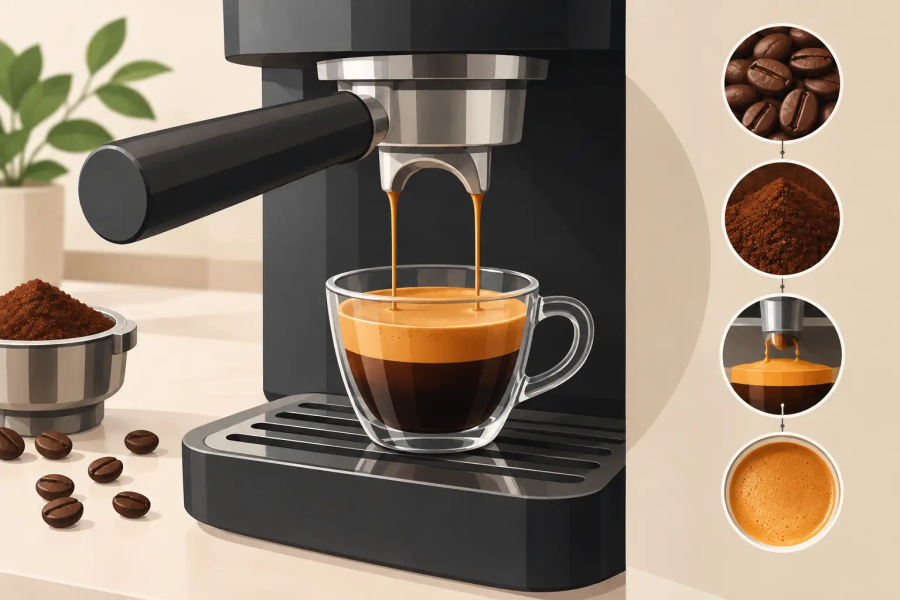
How is crema formed in an espresso? Find out how the beans, roasting, grind size, freshness and technique all influence the delicate, fragrant layer of foam and the flavour.
The first espresso of the day often reveals its secrets at first glance: a hazelnut-brown crema, finely textured, fragrant, and stable enough to linger for a moment. Those searching for "how is espresso crema created" usually want to understand precisely that—and know why it's sometimes missing at home. The short answer: crema isn't created by a single trick. It's the visible result of suitable beans, fresh roasting, the correct grind, clean technique, and a well-adjusted espresso.
How is crema formed in espresso?
Crema is the dense, golden to reddish-brown layer of foam on top of a freshly brewed espresso. It forms when hot water is forced through finely ground coffee under high pressure. During this process, carbon dioxide, coffee oils, and numerous aromatic compounds are released from the grounds. As soon as the espresso flows into the cup and the pressure releases, the gas escapes in tiny bubbles.
These bubbles are enveloped and stabilized by dissolved substances and the finest coffee oils. This creates not an airy milk foam, but a particularly fine emulsion: the crema. Its color ranges from light honey tones to dark hazelnut brown. A slightly marbled pattern, often called tiger stripes, can be a good sign. However, it is not proof that the espresso will automatically taste excellent.
That's the crucial point: A beautiful crema and a good espresso often go hand in hand, but they are not the same. Even an espresso with a perfect appearance can taste bitter, flat, or unbalanced. What truly matters is what the aroma, body, and flavor in the cup tell us.
The bean lays the foundation
Not all coffee produces the same crema. Arabica beans often offer a complex, delicate aroma with notes of caramel, chocolate, fruit, or honey. Robusta beans, in many cases, contain more natural compounds that promote a particularly rich and stable crema. This is why classic Italian espresso blends often include Robusta. However, it should not exceed 10%.
Origin, processing, and bean density also play a role. Highland coffees grow more slowly, often developing a high aromatic density and reacting differently during roasting than coffees from lower altitudes. With Grand Cru coffees, it's therefore worthwhile not only to look at the crema but also to consciously savor the character of the bean.
The roast: Development instead of darkness at any price
For espresso, beans are usually roasted darker than for a light filter coffee. This results in more body, lower perceived acidity, and aromas reminiscent of cocoa, roasted nuts, dark chocolate, or caramel. These qualities contribute to a rich, harmonious espresso. Due to its lower acidity, every espresso blend can also be enjoyed as filter coffee.
Very dark roasted beans can produce a rich crema, but too much roasting quickly masks the origin and introduces burnt or ashy notes into the cup. A good espresso roast strikes the right balance: sufficiently developed for sweetness, body, and solubility, yet roasted gently enough to preserve the coffee's subtle characteristics.
At Vee's Coffee, beans are freshly and gently roasted by hand every day. This is particularly valuable for espresso, as freshness determines not only the aroma when opening the package, but also how vibrant the coffee is when brewed.
Freshness is provided by carbon dioxide.
Coffee beans release carbon dioxide after roasting. This gas is an important component of the crema. If the beans are very old, a large portion of it has already escaped. The espresso then often runs quickly and thinly, and the crema remains pale, coarse, or dissolves quickly.
Freshly roasted beans aren't always ideal for espresso machines either. In the first few days, the beans can still contain so much gas that the extraction becomes unstable and the flavor unbalanced. Many espressos reach their best balance after a few days of resting, up to about two or three weeks after roasting. The exact timeframe depends on the bean, the roasting profile, and storage conditions.
Store coffee in an airtight container, in a dry place, and away from light. It's best to buy quantities that you can consume within a reasonable timeframe and grind the coffee just before brewing.
Grind size and distribution are crucial in the sieve.
Even the best beans can't produce a convincing crema if the grind isn't right. For espresso, the coffee grounds must be significantly finer than for filter coffee, but not powdery. If it's too coarse, the water rushes through too quickly. The espresso tastes watery, the crema pale and unstable, and the flavor often acidic and weak.
If the grind is too fine, the water backs up. The extraction takes too long, and the espresso can taste bitter and dry. While the crema may sometimes be dark and thick, it's more likely to indicate over-extraction than enjoyment. A rich, creamy surface is not a guarantee that the coffee is ground too finely.
As a starting point, you can use about 18 grams of ground coffee for a double espresso and extract approximately 36 grams of espresso in about 25 to 30 seconds. This isn't a hard and fast rule, though. Different beans require individual adjustments. A fruity, light roast coffee might react differently than a strong, chocolatey espresso roast.
Equally important is even distribution in the portafilter. Clumps or unevenly compacted coffee grounds create channels through which the water rushes too quickly. This so-called channeling leads to uneven extraction: some of the coffee tastes underdeveloped and sour, while other parts are bitter. The crema can also appear patchy or coarse. Therefore, distribute the grounds carefully and tamp them straight, evenly, and without excessive force, comparable to a weight of 15 kg.
Pressure, temperature and clean water
An espresso machine generates the necessary pressure for gases, oils, and aromas to combine in the desired way. Ideally, the coffee flows from the portafilter as a steady, viscous stream, gradually lightening in color towards the end. If it sprays wildly or drips only hesitantly, it's worth checking the grind size, dosage, and distribution.
The brewing temperature also shapes the crema and the flavor. Water that is too cool often doesn't extract enough from the coffee. The result can be acidic, weak, and pale. Water that is too hot promotes bitter, harsh notes and causes delicate aromas to disappear. Many espressos fall within a good range of around 90 to 94 degrees Celsius, but here too, the ideal setting depends on the roast.
Water is often underestimated. If it's very hard, limescale and minerals can affect the machine and the taste. If it's completely low in minerals, the espresso may lack body. A clean portafilter, a residue-free shower screen, and filtered, appropriately mineralized water are not trivial matters. They create the conditions under which a good bean can show its full potential.
What the crema reveals about your espresso
A smooth, fine-pored crema in a warm hazelnut brown color is usually a good sign. Very large bubbles, on the other hand, often indicate a grind that is too coarse, old beans, or an uneven extraction. An extremely dark crema that breaks up quickly can result from a grind that is too fine or from an excessively high temperature.
Consider these characteristics as clues, not judgments. Savor the espresso consciously. Does it smell of chocolate, almond, caramel, or ripe fruit? Is it smooth and sweet, pleasantly strong, or too bitter? Does it leave a velvety mouthfeel, or does it seem empty? The quality only reveals itself in the interplay of crema, aroma, and taste.
When starting with a new coffee blend, only change one variable at a time. Grind finer or coarser, then adjust the amount if needed and observe the brewing time. This way, you'll truly get to know your coffee instead of getting lost in many settings at once.
A beautiful crema is a little welcome from the cup. Give it the right conditions – freshly roasted beans, a good grinder, and a little attention – and then, above all, enjoy the moment when the aroma and taste accompany the first sip.