


Choosing the right cappuccino coffee beans for home use
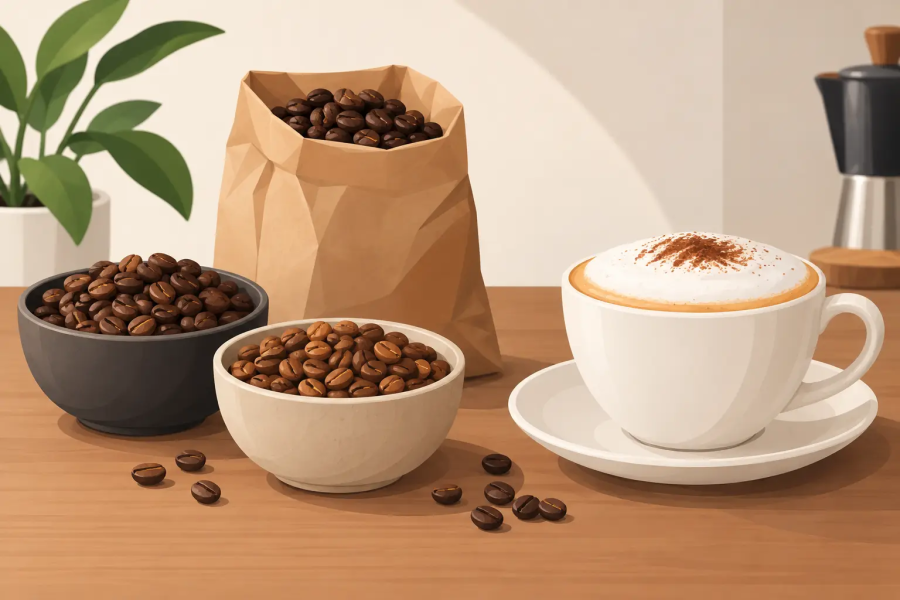
Choosing the right coffee beans for cappuccino: understand roasting, origin, freshness and grind size - for creamy milk foam and full espresso enjoyment.
The first sip is crucial: Does your cappuccino taste of warm chocolate, caramel, and delicate sweetness—or does it taste thin and bitter, with the espresso disappearing into the milk? Those who want to choose the right coffee beans for cappuccino shouldn't just look at the "espresso" label. Milk brings its own sweetness, fat, and rich texture. The bean needs to have enough body and aroma to stand out, but at the same time, it should be well-rounded enough so that the flavor doesn't become harsh due to too much Robusta.
A good cappuccino therefore begins before the grinder. Origin, roast, freshness, and the composition of the beans determine whether your portafilter produces a velvety espresso, on which finely textured milk foam can truly shine. Hello! Can you smell that aroma of freshly ground coffee? That's precisely the difference between just any old latte and a cappuccino you'll want to make again.
Which roast goes best with cappuccino?
For cappuccino, medium-dark to dark roasted beans from Vee's are usually the most reliable choice. They combine the natural sweetness of the coffee cherry with roasted aromas that come through beautifully in the milk. Think dark chocolate, hazelnut, caramel, cocoa, or roasted almonds. These notes create a robust espresso without being overpowered by the milk.
Very light roasts can be fascinating, especially if you enjoy bright fruit, blossom honey, or juicy cherry notes. However, using them in a cappuccino requires some experience: the vibrant acidity can quickly become more pronounced than expected when combined with milk. So, a light roast isn't necessarily a bad choice, but it's more suited to those who are curious, consciously seeking a lighter, fruitier flavor profile, and who can precisely adjust their espresso.
Very dark roasts produce a lot of body and little acidity. This can be suitable for a classic, Italian-style cappuccino. However, if beans are roasted too dark or extracted at too high a temperature, smoky, dry, and bitter notes become prominent. Milk doesn't reliably mask these—sometimes it even accentuates them. Therefore, it's better to look for a gentle roast with full color and flavor rather than simply dark roasts.
Why milk requires a different bean
An espresso that tastes wonderful on its own isn't automatically the best cappuccino espresso. Without milk, delicate citrus notes, tea aromas, or a subtle acidity can take center stage. With milk, you need more substance: sweetness, body, and a clear roasted aroma. The coffee bean should hold its own without overpowering the creamy milk.
As a general guideline: the more milk you use, the stronger the coffee can be. For a classic cappuccino with about one-third espresso, one-third hot milk, and one-third milk foam, a well-rounded, chocolatey espresso is perfect. For a large latte, the blend can be even stronger. If you drink your cappuccino small and intensely flavored, more delicate, single-origin highland coffees can also be very interesting.
Arabica, Robusta or blend.
Pure Arabica beans often bring elegant sweetness, nuanced aromas, and a pleasant, delicate acidity to the cup. A Brazilian Arabica might taste of nuts and chocolate, while a Central American coffee might offer notes of caramel and honey. Such profiles provide an excellent foundation for a harmonious cappuccino—especially if you prefer softer, sweeter cups.
In an espresso blend, a moderate Robusta content of no more than 10% can deliver exactly what milk-based drinks need: a rich, stable crema. Those who prefer a classic, strong espresso with a generous crema will often find the perfect match in an Arabica-Robusta blend (90-95% Arabica, 5-10% Robusta).
What matters is not the label "100% Arabica" or "with Robusta," but the quality of the green coffee beans and the roasting process. Grand Cru coffees with traceable origins don't taste better because they have complicated descriptions, but because the selection, processing, and roasting are carried out with care. And don't forget to try: your favorite bean depends on your taste and your coffee machine.
Choosing the right cappuccino coffee beans according to taste
If you can define your taste, the selection becomes delightfully simple. Do you want a cappuccino reminiscent of cocoa and melted chocolate? Then opt for a medium-dark espresso roast with a chocolatey, nutty profile. It's particularly well-rounded with cow's milk and harmonizes equally well with many barista-style oat drinks, such as Vee' Italian Roast d'Oro.
If you love caramel, nougat, and a soft sweetness, coffees from Brazil or balanced blends with South and Central American beans, such as Vee's Espresso Roma, are a good choice. They are often approachable, full-bodied, and more forgiving of minor variations in grinding than very light roasts.
Do you prefer something more vibrant? Then a coffee with notes of red berries, cherry or honey, like Vee's Espresso Santo Domingo Royal, might be appealing.
Freshness is not a secondary matter.
Coffee is a natural product, and its aroma changes after roasting. Freshly roasted beans initially release carbon dioxide and need a little time to settle before they brew particularly evenly in the portafilter. Afterward, the phase begins in which the aroma and sweetness develop beautifully. Therefore, it's better to buy quantities that you can enjoy within a few weeks rather than storing them for months.
Store the beans in an airtight container, in a dark place, and at normal room temperature. Grind them as close to brewing time as possible. The difference between whole beans and ground coffee is often only a matter of minutes, but it can make a world of difference in taste.
At Vee's Coffee, the beans are freshly and gently roasted by hand daily and packaged while still warm. This freshness is particularly beneficial for cappuccino, as the aromas not only remain noticeable in the espresso but also blend with the milk to create a clear, sweet overall flavor.
The best bean needs the right grind.
Even the most careful selection can disappoint if the grind isn't right. If the espresso runs too quickly, it often tastes thin, acidic, or watery. If it runs too slowly, it becomes bitter, dry, and heavy. For cappuccino, you want an espresso with body and sweetness: concentrated enough for the milk, but not burnt.
Start with a dose that matches your machine and observe the brewing process. If the coffee flows quickly and is light in color, grind finer. If it drips slowly and is very dark, grind coarser. Only change one small amount at a time. This way, you'll get to know your beans better, instead of overwhelming them with several changes at once.
The milk also deserves attention. It should be cold from the start and only heated to about 60 to 65 degrees Celsius. Milk that is too hot loses its natural sweetness and quickly tastes cooked. Fine, glossy microfoam supports the espresso better than large, dry bubbles. A good cappuccino shouldn't consist of coffee under a layer of foam, but rather of espresso and milk blending together.
When a trial pack makes more sense
If you've only ever had supermarket espresso or are torn between chocolatey and fruity flavors , a sampler pack is the most convenient shortcut. Prepare several varieties under as similar conditions as possible and don't just note "good" or "bad." Ask yourself: Does the coffee flavor linger in the milk? Is it more sweet, nutty, spicy, or fruity? Would I want a large cup of this in the morning or a small, intense cappuccino after a meal?
The "coffee finder" on Vee's website can provide additional guidance, but ultimately, your palate has the final say. The perfect cappuccino bean isn't necessarily the strongest or most expensive. It's the bean where espresso, milk, and your personal taste come together perfectly every morning—and whose aroma makes you look forward to that first sip as soon as you open the package.